Dallas / Austin / San Antonio / Houston DFW Area Photometric Surveys, Consulting & Exterior Light / Lighting Level Testing / Lux Surveys as 3rd Party Photometric Inspections

Texas Lighting Consulting: As-Built Photometric Surveys, Lux Testing, and Lighting Compliance Across Texas
IES (Illuminating Engineering Society), Full Member LC (Lighting Certification) pending through the NCQLP (National Council on Qualifications for the Lighting Professions) [214] 912-4691
Texas Lighting Consulting performs independent, third-party as-built photometric surveys: the field measurement of lighting that already exists on the ground, in foot-candles and lux, against the limits a municipality actually enforces. Our work supports Certificate of Occupancy approvals, exterior-lighting Letters of Compliance, corporate lighting standards, and forensic and crime-safety lighting assessments. We are a recognized photometric resource for a number of North Texas municipalities, and we travel statewide and nationally for larger commercial projects.
We measure what the building inspector measures. Most Texas ordinances set glare and trespass ceilings (and occasionally minimums) at the property perimeter and beneath luminaires, with the allowable values keyed to how the adjacent parcel is zoned. A commercial pole light that performs fine on paper can still throw a measurable reading across a property line into a neighboring residential bedroom window, and that is precisely the reading an ordinance exists to catch.
One distinction that decides most jobs: horizontal versus vertical. Calculated photometric plots almost always report illuminance on the horizontal plane, sensor facing up, measuring light landing on the pavement. Most municipal ordinances instead require a vertical measurement, sensor facing toward the source at a fixed height (commonly 3 feet or 5 feet), which represents what a standing person actually perceives looking toward the fixture. Some cities require both. When a plan reports only horizontal grade values and the city checks vertical, the as-built can fail even though the paperwork looked clean. We measure to the plane the ordinance specifies.
Why brand-new installations read brighter than the plan. This is the failure we see most, and there is a concrete reason for it that designers often miss. A calculated plot reports maintained illuminance, which is the initial output multiplied by a light loss factor (LLF) that anticipates years of lamp lumen depreciation and dirt accumulation. For modern LED systems that LLF commonly sits around 0.70 to 0.85. A freshly commissioned install, however, is at initial output: the lights have not yet depreciated. The result is that a day-one as-built can measure roughly 15 to 30 percent above the maintained values printed on the plan, before a single other variable is considered. Add the steadily rising lumen-per-watt efficiency of new LED product, and the gap between calculated and measured widens further. (Technical note flagged: the 15 to 30 percent figure is a derived estimate from typical LED LLF ranges, not a measured constant; the exact spread depends on the specific LLF the designer applied.)
What we measure and report:
- Exterior perimeter and property-line foot-candle levels against the governing ordinance, on the required plane
- Light trespass and glare onto adjacent residential or differently-zoned parcels
- Interior task, egress, stairwell, exit-sign, and parking-structure illuminance where minimums apply (retail, industrial, medical, hospitality)
- Forensic and security lighting: ambush-point identification, dark zones, camera-illumination adequacy
- Flicker-rate and datalogging studies over short or extended intervals
- UV-A, UV-B, and UV-C intensity surveys (240 to 390 nm including the 254 nm germicidal UV-C) line for safety, material preservation, and process verification
We use high-resolution, cosine- and color-corrected meters reading to 0.01 foot-candle, which matters near residential zones where limits commonly fall to 0.25 foot-candle and ordinary meters lose resolution.
A framework worth knowing. Many Texas exterior-lighting codes inherited their structure from the 2011 Model Lighting Ordinance, a joint IES and International Dark-Sky Association document that introduced lighting zones (LZ0 through LZ4) and the BUG rating system (Backlight, Uplight, Glare) defined in IES TM-15. The MLO itself is no longer updated, and DarkSky International (the IDA’s current name) now maintains a separate Municipal Code template, but the BUG and lighting-zone vocabulary it established still appears throughout municipal code and on the cut sheets you will be handed. A growing number of ordinances also now cap correlated color temperature, frequently at 3000 K or lower, which is a parameter a horizontal-only calculation will not surface at all.
An important boundary. Texas Lighting Consulting does not produce the calculated photometric plots submitted to a city for permit. We perform as-built field testing of installed systems only. For calculated design work in Texas, we refer clients to a reputable photometric engineering firm (see below). We are increasingly engaged across northern Austin, San Antonio, and Houston, and we understand the cities of Seagoville, Crowley, and possibly Celina are now moving toward exterior photometric enforcement.

Need a Dallas / DFW / North Texas / Austin – San Antonio / Houston Area Photometric Survey?
Please provide the following information for Photometric Surveys:
CRITICAL 1: Photometric lighting plan from the PE (Professional Engineer) showing the property layout, locations of fixtures and predicted light levels in candlepower. Texas Lighting Consulting asks that this be sent in either the ORIGINAL PDF format or a HIGH RESOLUTION *.png or *.jpg file. Lately clients have been sending low resolution graphics files which do not clearly show the calculated foot candles.
McKinney Hangar – Photometric Survey Site Plan PDF Format
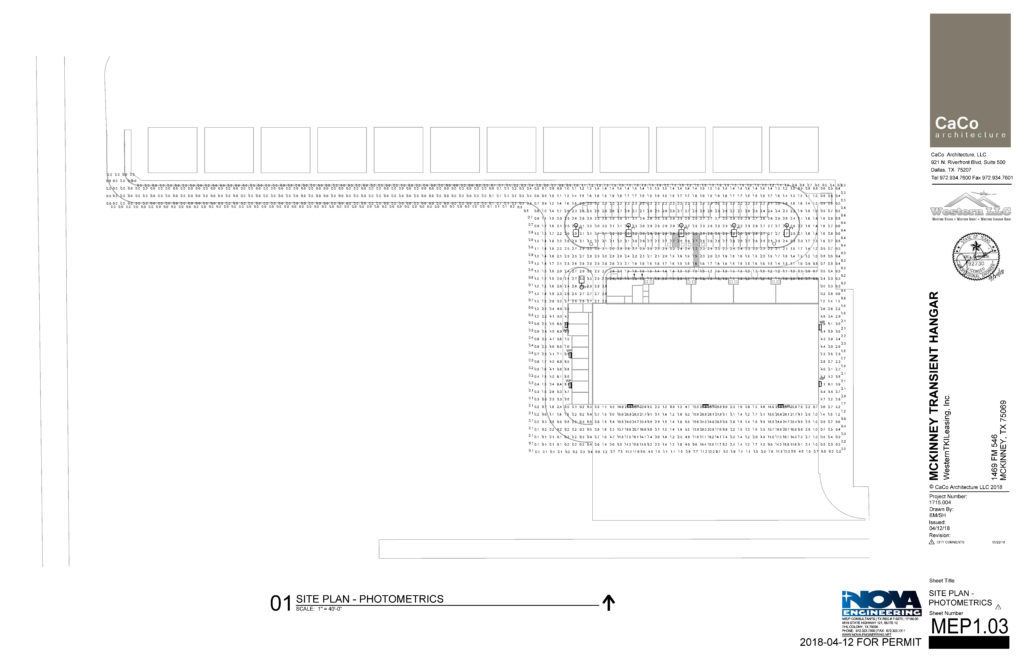
CRITICAL 2: The photometric plan should either show the PROPERTY LINE demarcations as well OR you may need to submit a separate site plan which reflects the property boundaries as shown below:

- The physical address of the site, with suite and zip, or the nearest intersection and corner for new builds that do not yet appear in mapping software.
- The nature and name of the business to be surveyed (for example, a children’s hospital, a steel foundry, a quick-service restaurant), plus any permit numbers tied to the Letter of Compliance.
- Confirmation that all exterior lighting (every fixture, bulb, and breaker) is functional and will be on through the night of the survey. Note any change orders moving, adding, or deleting fixtures. Texas Lighting Consulting is not responsible for failed inspections caused by lights being off during the agreed window, including electrical faults, timer or photocell issues, unclear panel labeling, improper design, or excessive brightness, nor for design and installation choices such as fixture angle, mounting height, missing shielding, or absent dimming. The initial test is billed in full whether the result is a pass or a fail; follow-up testing is typically prorated, depending on distance and scheduling.
- If lighting runs on a timer or photocell, disable it and leave the fixtures manually on for the survey window. Arrival times shift with sunset and project load across the year.
- Whether you are the General Contractor, the owner, or both, with your name, title, company, business address, email, and best phone number.
- Your timeline. Surveys depend on weather and visibility (a minimum of roughly 6 nautical miles), so they cannot run on rainy or heavily overcast nights.
- Any site access details: gates, locks, lockboxes, access codes, an on-site contact, and any security personnel or monitoring company that should be notified in advance of a nighttime survey.
- Preferred form of payment. We invoice through Square for mutual convenience. For Certificate of Occupancy work we request payment on receipt of the report, generally same-day, again regardless of a pass or fail result.
City-specific notes:
- McKinney: Provide the project name and permit number (the COM number, not the DEV number) for the Letter of Compliance, which we hold as a Word template. Separate addresses carry separate permit numbers. The current LOC references the Unified Development Code dated 3/31/25, Article 6 (Exterior Lighting), which replaced the older Chapter 58.
- Plano: The as-built survey must be stamped by a PE, ideally the engineer who produced the calculated plan. We can recommend a local firm to sign off if needed.
- Grapevine: The as-built may be signed by a PE or a Master Electrician. We can refer a photometric-design firm if required.
- Prosper: Provide project name and permit number (format like COM 21-0084) for the LOC. Note that the city’s Site Lighting Verification Form (rev 06.2023) must be completed by the Design Professional of Record, not by us, since we perform field surveys rather than design. Our LOC can be supplied to that professional to support their sign-off. [Link: Prosper Site Lighting Verification form, prospertx.gov, verify live before publishing]
- Flower Mound: Uses an LOC similar to McKinney’s. Per the Commercial Construction Packet (page 9, item 11n), a certified exterior-lighting letter from the design professional must state that the lighting meets Town Ordinance 98, Division 6, Subdivision II.
Warning to architects and engineers: as-built LED light levels now routinely exceed what the calculated plot predicts, which can fail a Certificate of Occupancy, especially next to residential zones. Read our companion article on why this is happening and how to avoid it: Photometric and Exterior Lighting Design Considerations: Architects and Engineers Beware.
Please read the photometric engineering / consulting article on this phenomena:

Lighting Design Issues at Odds with City Ordinances – Texas Lighting Consulting Performs Lighting Consulting for Compliance
Service area. Dallas, Fort Worth, and the greater DFW metroplex including Plano, Frisco, McKinney, Allen, Prosper, Grapevine, Southlake, Flower Mound, Euless, Bedford, Hurst, Keller, Coppell, Carrollton, Richardson, Rockwall, Heath, Garland, Mesquite, Grand Prairie, Arlington, Irving, Lewisville, Denton, and surrounding cities); the Austin and San Antonio corridor (Round Rock, Georgetown, Cedar Park, San Marcos, Pflugerville); and the Houston area (including The Woodlands and Spring). Counties include Dallas, Collin, Denton, Tarrant, Rockwall, Travis, and Harris.
Many cities such as McKinney, Prosper, Plano, Frisco, Southlake, Flower Mound, Celina, Euless, North Richland Hills, Keller, Grapevine, Allen, Rockwall, Richardson, Lake Worth, Heath, Sachse, Round Rock, Georgetown, Pflugersville, Glen Rose, Justin and Mesquite have exterior lighting / photometric illumination / glare ordinances in foot candles which limit the amount of light which can emanate from the borders and perimeters of a property as well as the amount of lighting reflected from the ground. (glare) The amount allowed depends on how the neighborhood is zoned. (residential / light commercial, industrial etc.) Exterior parking lot lighting (particularly from pole luminaries) may cause excessive light to be transmitted through the windows of an adjacent residential zoned bedroom window in which case light level testing is called for. In many cases the lighting survey data is compared to photometric maps prepared by a lighting or other relevant professional engineer.
Additional rapidly developing municipalities with exterior-lighting and photometric requirements include Anna, Hutto, Kyle, Leander, Buda, Liberty Hill, Princeton, Fate and Melissa. Requirements vary by jurisdiction: some mandate third-party as-built testing or a compliance letter, while others require approved photometric plans and may request field verification when installed conditions differ from the approved design or during final inspection.
Larger commercial projects served nationally on request.
*LEGAL NOTICE*
All information on this website either written or implied is the express opinion of Texas Lighting Consulting and its owners are not responsible or liable for any damages arising from the misuse, misinterpretation or other consequences of the content of this website either in whole or in part. This includes but is NOT limited to all external weblinks, documents, photos or other references (informational or otherwise) to 3rd party references including government agencies, health organizations, etc.
Texas Lighting Consulting: Professional Photometric Consulting | Photometric Lighting Surveys and Inspections
Phone: (214).912.4691 https://texaslightingconsulting.com/
15770 Dallas Pkwy Dallas, TX 75248
COPYRIGHT 2014 – 2026